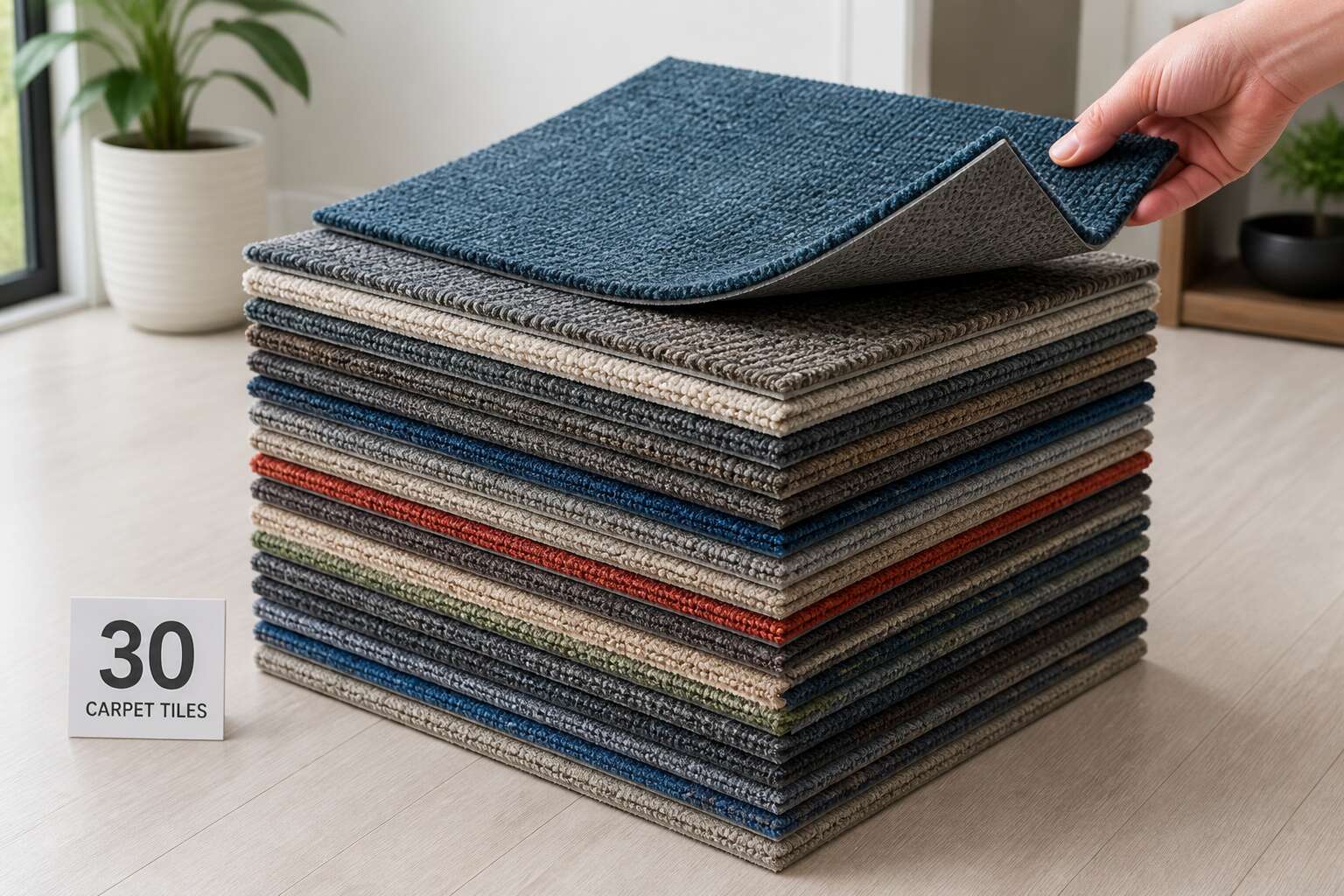
Understanding the 30-Pack Carpet Tile Format
What Is Included in a Standard 30 Pack
A carpet tiles 30 pack begins with a simple calculation. Thirty squares of 50 by 50 centimetres lay out to 7.5 square metres of floor. That covers a small office, a rental bedroom, or a narrow passage. What I appreciate most is the consistency of the box itself.
- Thirty tiles with adhesive backing
- A diagram showing the recommended stagger pattern
- A batch reference for future colour matching
The backing material changes everything. Bitumen grips bare concrete well, while PVC backs work over underfloor heating. The nylon face fibre handles daily foot traffic with quiet resilience. A carpet tiles 30 pack is not a random assortment. It is a deliberate, repeatable system.
Coverage Area and Tile Dimensions
Thirty squares, each half a metre on a side, sounds manageable until you sketch the floor plan. The full box lays out to 7.5 square metres, which fits a compact bedroom or a corridor that refuses to be straight. Tile dimensions drive everything.
- 50 by 50 centimetres per tile
- 0.25 square metre per tile
- 30 tiles multiplied by 0.25 equals 7.5 square metres
That coverage assumes you do not chop half the pack into awkward wedges. In practice, a few tiles vanish into door frames and radiator pipes, which trims the usable area. A carpet tiles 30 pack remains a reliable option for South African rentals where the floor is concrete and the budget is honest.
Common Uses for a 30-Pack
Understanding the format goes beyond counting squares. A carpet tiles 30 pack gives you flexibility to mix patterns or replace damaged sections later. That modular nature matters when the layout changes. If one tile stains, you lift it out and slot in a fresh one. No waiting for a professional. Keep the spare box for later repairs. For South African homes, this format suits open-plan kitchens, study corners, or a rental flat with cold concrete floors.
Common uses follow the logic. A carpet tiles 30 pack transforms a couple of small zones. People use them for:
– Home office floors that need warmth underfoot.
– Play areas where spills happen.
– Rental bedrooms with cold concrete slabs.
The tiles also work in hallways and studio apartments. You can stagger the layout, extend it, or pull it up when you move. That practicality keeps the format popular.
Advantages of Buying Carpet Tiles in Bulk Packs
Cost Savings Compared to Individual Tiles
When I work through flooring budgets with clients, one figure always stands out. A carpet tiles 30 pack reduces the per tile cost significantly compared to buying the same quantity individually. Suppliers build packaging, handling, and distribution overhead into each single tile, which is why that price creeps upward.
Bulk packs also solve the shade variation problem. Tiles from the same production run arrive together, ensuring the colour stays consistent across the whole floor. Fewer separate orders mean delivery charges combine into one consolidated shipment.
- Lower unit price per tile
- One delivery fee instead of several
- Fewer chances for ordering mistakes
For a commercial space in Johannesburg or Cape Town, the saving can cover extra adhesive or spare tiles for future repairs. The numbers add up faster than most people expect.
Simplified Ordering and Logistics
Anyone who has coordinated a flooring installation knows the quiet dread of a missing delivery. A carpet tiles 30 pack removes that anxiety by condensing the entire ordering process into a single transaction. You place one order, receive one consignment, and sign one delivery note. That simplicity matters on a construction site in Johannesburg, where a delayed shipment can halt an entire schedule.
The logistics become remarkably tidy. Instead of chasing multiple couriers, you coordinate a single drop off. Instead of reconciling several invoices, you file one. This reduction in administrative friction is a courtesy to yourself and your team.
- One order, one delivery window
- One invoice, one supplier contact
- Simplified stock management on site
The social grace here is underrated. Suppliers appreciate clear, straightforward requests. A carpet tiles 30 pack communicates intent and reduces back and forth email chains. That efficiency builds goodwill, which pays dividends when you need advice or a quick answer.
Perfect for Medium-Sized Rooms
Buying in bulk for a medium sized room is about securing uniformity. A carpet tiles 30 pack comes from a single production batch, so the colour and texture match perfectly. You cover a typical home office or bedroom in one purchase, with no guesswork on square meters. I have seen too many projects fail on that simple point.
There are practical advantages that only show up later:
- Spare tiles for future repairs, because stains and scuffs happen.
- Uniform thickness across the whole floor, so edges sit flush.
- A complete unit that stays together, instead of scattered remnants.
That last point matters. Most installations stall because someone miscalculated the area. A full pack removes that risk entirely.
Availability of Styles and Colors
The colour options for a carpet tiles 30 pack often exceed what a shop stocks for individual tiles. A store might display four neutrals on the shelf, but a full carton brings out a dozen shades. That breadth matters when a room needs one specific tone to match timber doors or a favourite fabric.
Bulk buying also protects the design later. I have seen a farm office in the Free State ruined by trying to match new tiles to an old floor. A carpet tiles 30 pack avoids that scramble. The advantages of buying carpet tiles in bulk packs show up in the choice itself:
- Textured loop weaves, dense cut piles, and subtle patterns stay available because the factory runs a full batch.
- Two colours from the same line can be laid together without dye lot differences.
- Stronger accent colours become reasonable choices when the base tiles share one backing.
That selection, secured in a single carton, is hard to replicate with leftover pieces from different shops.
How to Determine Your Carpet Tile Needs
Measuring Your Room Accurately
Many South African rooms have quirks, such as bay windows or built-in cupboards, that complicate floor plans. To determine your needs, measure each wall segment at three heights: near the floor, midway, and at skirting level. This reveals subtle curves that throw off calculations.
- Length and width from the longest points
- Depth of alcoves and recesses
- Distance between door frames and corners
Record these in centimetres, then multiply to find square metreage. A carpet tiles 30 pack often covers around 8.5 square metres when tiles are 61 by 61 centimetres. Compare that to your measured total, and a five percent allowance for trimming is typical. This method works well for L shaped lounges and irregular bedrooms.
Factoring in Waste and Cutting
An ideal room exists only on paper. Installation happens in the real one, and I have watched even careful installers pad their numbers after the first misplaced cut. The wandering blade, the recut, the tile that chips near a threshold. These are not anomalies. They are the material cost of installation.
A simple rectangle needs five percent waste to cover cutting errors and final trims. Irregular spaces ask for more. The following features each tax your tile supply:
- Door frames that demand notched corner cuts
- Alcoves and recesses where the layout turns a corner
- Diagonal installation, which increases edge waste with every row
Apply the waste factor before comparing your total to a carpet tiles 30 pack. If the calculated area plus waste exceeds the pack’s coverage, add another pack! Running short means waiting on a second delivery, and the exact dye lot may not match.
Using a Carpet Tile Calculator
Most flooring quotes are wrong because they treat the room as a rectangle. A carpet tile calculator does the opposite. It breaks your floor plan into smaller sections, applies the waste factor, and converts the total into full packs. For a carpet tiles 30 pack, the calculator tells you whether one box covers the space or a second order is needed.
You enter the length and width of each area, including alcoves and doorways. The tool divides the total square metres by the coverage of a single tile and rounds up to the nearest pack. This removes guesswork.
A calculator also lets you test different layouts:
- straight lay versus diagonal installation
- multiple rooms using one order
- tight spaces where partial tiles dominate
In my experience, a carpet tiles 30 pack order rarely fails when the numbers come from a calculator.
Comparing Needs with a 30-Pack Quantity
The real test of a flooring order is whether the tile count matches your floor plan, not the square metre figure alone. I convert my measured area into individual tiles, then compare that number against a carpet tiles 30 pack. This comparison reveals a simple truth; a room requiring 26 tiles fits into one pack, but a space demanding 34 tiles forces you to buy sixty, with ten tiles left over.
Several variables shift your tile count:
- The grain direction in a patterned tile demands extra cuts.
- A herringbone or staggered layout increases the offcut count.
- Door thresholds and built-in cabinets break the grid, creating partial tiles.
For most South African bedrooms and small offices, a carpet tiles 30 pack is the right modular size. I order one pack for spaces under 22 square metres, two packs for anything larger. This approach keeps the budget predictable and the installation smooth.
Step-by-Step Installation Guide for Carpet Tile Packs
Preparing the Subfloor
Nearly 70% of carpet tile failures begin with a subfloor that was never properly prepared. That statistic alone makes me obsess over every square centimetre before I even open a carpet tiles 30 pack! The ground beneath your feet needs to be flat, dry, and structurally sound.
- Remove all furniture and vacuum the entire area.
- Fill any cracks with a cement-based patching compound.
- Perform a simple plastic film moisture test overnight.
If the film shows beads of water, install a vapour retarder first. Level out depressions with a self-leveling compound, then grind down ridges. Finally, wipe with a damp mop and let it dry completely. Remember, dust is your enemy here. Take your time with this stage and the rest of your installation will feel effortless.
Planning the Layout
A room’s geometry rarely cooperates with your first instinct. Begin by locating the true centre, because a carpet tiles 30 pack rewards patience here. Snap chalk lines between the midpoints of opposing walls; your tiles will follow these axes. Dry lay a test row along each line and adjust the offset until edge cuts mirror each other.
Consider these layout factors:
- Doorway thresholds and undercut jambs
- Natural light direction, which reveals every seam
- The least visible wall, where slight deviations can hide
If the room deviates from square by more than 6 mm over 3 m, shift your grid toward that hidden wall. Number each tile in pencil before peeling any backing from your carpet tiles 30 pack; this sequencing prevents rework.
Adhesive Options for Carpet Tiles
Now the grid is set and the tiles are numbered. Peel the backing from the first tile and place it exactly where the chalk axes cross. Work outward in a pyramid pattern rather than long rows, because a pyramid spreads pressure evenly and keeps the grid honest.
Adhesive choice deserves more thought than the average DIYer gives it. Peel and stick tiles from a carpet tiles 30 pack win on speed. Pressure sensitive adhesive suits concrete slabs, the standard floor in many South African homes. Wet adhesive is messy, but it allows time to slide tiles before it grabs.
- Peel and stick: fastest, cleanest, reversible
- Pressure sensitive: durable on big installations
- Wet adhesive: permanent, forgiving during alignment
Roll every tile in your carpet tiles 30 pack after placement. A rented floor roller forces out trapped air and secures the edges.
Tips for Cutting and Fitting
Cutting is where most installations go wrong. For a carpet tiles 30 pack, you need a sharp utility knife, a straight edge, and a cutting board. Mark each tile face up, then score the backing without slicing through your fingers. A neat trick is to cut several tiles at once by stacking them, but only when the pattern allows it.
Here is the sequence I use:
1. Measure the gap at the wall, subtract 10 mm for expansion.
2. Mark the tile on the back to avoid torn fibres.
3. Score with firm pressure, then snap along the line.
4. Trim the last row against a cardboard template.
Fitting around door frames means undercutting the architrave. Slide the tile under the frame rather than trimming the tile to fit, because a 30-pack rarely includes spare material once waste is factored in. The result is a cleaner edge and a faster install.
Finishing Edges and Transitions
Finishing edges is where a carpet tiles 30 pack either looks deliberate or looks like a DIY experiment gone wrong. Transition strips are your best defence against frayed borders and rogue corners. They bridge the gap between tiles and hard flooring without demanding surgical precision.
– Use aluminium transition strips in high traffic doorways.
– Choose a matching edge trim for exposed sides near patios or staircases.
– Press edges down with double sided tape or a thin bead of adhesive.
The carpet tiles 30 pack quantity covers the floor, but the perimeter needs its own attention. A straight edge profile against a wall creates a crisp line and prevents curling. Nobody notices the transition until it is missing. That is the point of finishing well.
Design Inspiration and Patterns with Carpet Tile Packs
Classic Grid Layout
The classic grid layout is the design equivalent of a firm handshake. It does not try to impress. It simply works. A carpet tiles 30 pack gives you enough squares to cover a medium floor in this pattern, and each tile sits squarely against its neighbour. The seam lines soften, and the floor reads as one calm surface. This rhythm suits offices, rental flats and homes that want a no nonsense look.
Consider what the grid gives you!
- Straightforward alignment that saves installation time
- Clear repeats of the tile texture and colour
- Easy replacement of a single tile later
Keep the tiles pointed in the same direction. Many tiles have a subtle grain, and rotating them breaks the grid. Align the arrows and your carpet tiles 30 pack becomes a continuous whole. That consistency is the quiet strength of the pattern.
Checkerboard and Diagonal Patterns
A carpet tiles 30 pack enables a checkerboard with two contrasting shades. Alternate the squares in a strict sequence, and the floor gains a sharp, defined look. This pattern suits entrance halls and retail spaces. The even tile count of the 30 pack matters. You need balanced numbers of each colour, so order accordingly.
- Two colours from the same family create a subtle checkerboard
- Bold hues make a statement
Diagonal patterns require more cutting, but they change how a room feels. Tiles laid at 45 degrees push the eye along the longest axis, which can widen a narrow corridor. The layout hides joint lines better in irregular rooms. A carpet tiles 30 pack covers a similar area here, though edge cuts use more material. This approach asks for patience during installation, yet it delivers a dynamic result.
Mixed Colors and Textures
Mixing colors and textures from a carpet tiles 30 pack changes the psychological feel of a room more than any single shade could. A monochrome floor reads as safe. Introduce one contrasting tone, and the space becomes intentional. Texture adds another layer entirely. A loop pile next to a cut pile creates shadow without color. The result is quiet depth.
Consider the way light travels across the surface. Flip tiles in opposite directions and the pile catches the light differently. This simple shift creates a woven, almost organic surface from a carpet tiles 30 pack. It works because the human eye seeks variation. That variation can come from color or from how the material reflects the sun.
Some useful directions for mixed packs:
– Use three textures in equal measure for a balanced scatter
– Pair a dark, rough tile with a light, smooth one to define zones
– Keep one constant color and vary texture for a subtle, tactile rhythm
The same 30 pack can serve a quiet office or a lively studio. The difference is in what you choose to emphasize. Color grabs attention. Texture rewards touch. Both make the floor feel less like a product and more like a decision.
Creating Area Rugs and Runners
A carpet tiles 30 pack turns a bare slab into a bespoke floorcover without a special order. You can treat the square modules as a palette for building an area rug under a dining table or a runner down a long passage. In a Johannesburg apartment, I used twelve tiles to create a herringbone runner on concrete. The remaining tiles formed a quiet border.
The inspiration lies in modularity. Alternate tile direction to create subtle arrows. Use a few leftover pieces to edge a workstation.
Consider these patterns:
- Lay a central strip of ten tiles for a runner, then flank it with cut halves.
- Create a two tile wide rug frame with a one tile interior border.
The same carpet tiles 30 pack reshapes each room into a new spatial story.
Using Carpet Tiles in Commercial Spaces
Pattern in a commercial interior does more than decorate. It directs movement. When you work with a carpet tiles 30 pack, every module becomes a deliberate mark. A reception floor can shift from a rigid grid to a gentle fan pattern with the same inventory. This is the quiet power of modular design.
In South African offices, retail stores, and medical practices, maintenance plays a decisive role. A carpet tiles 30 pack simplifies repairs because damaged modules lift out individually. Consider these common placements in commercial settings:
- Entry lobbies where grime collects
- Meeting rooms where chairs roll and scrape
- Staff canteens that see constant spillage
The pattern language shifts with practical constraints. Dark tiles at an entrance read as a workhorse surface. Light tiles in a corridor guide the eye toward a destination. Commercial interiors benefit from this clarity.
Maintenance and Replacement Strategies for Carpet Tiles
Cleaning Methods for Carpet Tiles
I have watched office managers panic over a single coffee stain, only to realise a swap takes less time than brewing the next pot. That is the quiet superpower of a carpet tiles 30 pack. Unlike broadloom, a stained tile lifts out and a fresh one clicks into place without disrupting the whole room.
Cleaning matters between those moments. Vacuum high traffic zones weekly, and blot spills immediately with mild detergent. Scrubbing crushes the fibre; blotting saves it. For deeper grime, schedule an extraction wash twice a year.
The maintenance rhythm is simple:
- Rotate spare tiles from your carpet tiles 30 pack into worn areas to balance foot traffic.
- Store three or four spare tiles upright in a dry space for future swaps.
- Inspect adhesive corners quarterly and reapply when edges curl.
Replacement costs a fraction of a full refinish, making readiness the core strategy.
Stain Removal Techniques
I have seen a tile surrender to red wine before the guest even finishes apologising. When blotting fails and the stain settles, replacement becomes a strategic virtue. Lift the offending square, slide in a fresh one from your carpet tiles 30 pack, and the room reads as pristine. No drying time, no fading patch.
For stains worth rescuing, the right agent matters:
- Coffee and tea: blot with cold water, then a dash of white vinegar.
- Oil and grease: sprinkle bicarbonate of soda, leave it, then vacuum.
- Ink and marker: press with rubbing alcohol, never scrub.
Each technique preserves the tile’s structure, yet the real insurance lies in your spare pile. A carpet tiles 30 pack gives you a rotating reserve that turns maintenance into a quiet reflex.
How to Replace a Single Tile
When I replace a single tile, I start by heating the adhesive with a hairdryer for thirty seconds. Then I lift one corner with a stiff scraper, pulling slowly to avoid tearing the backing. After removing the square, I scrape the floor clean and confirm the surrounding tiles have not shifted.
Your carpet tiles 30 pack holds the exact match for a seamless swap. Before installation, inspect the grain direction, as some styles have a visible nap. Position the new tile under the adjoining edges, then press from the centre outward.
- Select a fresh square from your spare pile, matching the batch code.
- Apply a thin layer of adhesive or activate the peel and stick backing.
- Roll the surface with a heavy cylinder to settle the seams.
Prolonging the Life of Your Carpet Tiles
A busy passage concentrates wear on a narrow line of tiles. I mark each square under the backing with a chalk code and shift the central pathway with the quieter edges after each rainy season. This rotation slows the formation of permanent compression lines, the main indicator of ageing in any layout.
Humidity causes corners to lift. I run my thumb along each seam during routine cleaning and press any raised edge back down. If a tile has lost its grip, or the surface shows a crushed nap that no vacuum revives, that square has finished its service. I reach for the carpet tiles 30 pack and retire the old unit.
- moisture damage near exterior doors
- tiles that creak under foot pressure
- crushed pile that will not rise after vacuuming
Holding back the complete carpet tiles 30 pack keeps the entire installation consistent. A faded dented patch remains visible. A fresh tile from the same batch makes the repair disappear.

0 Comments