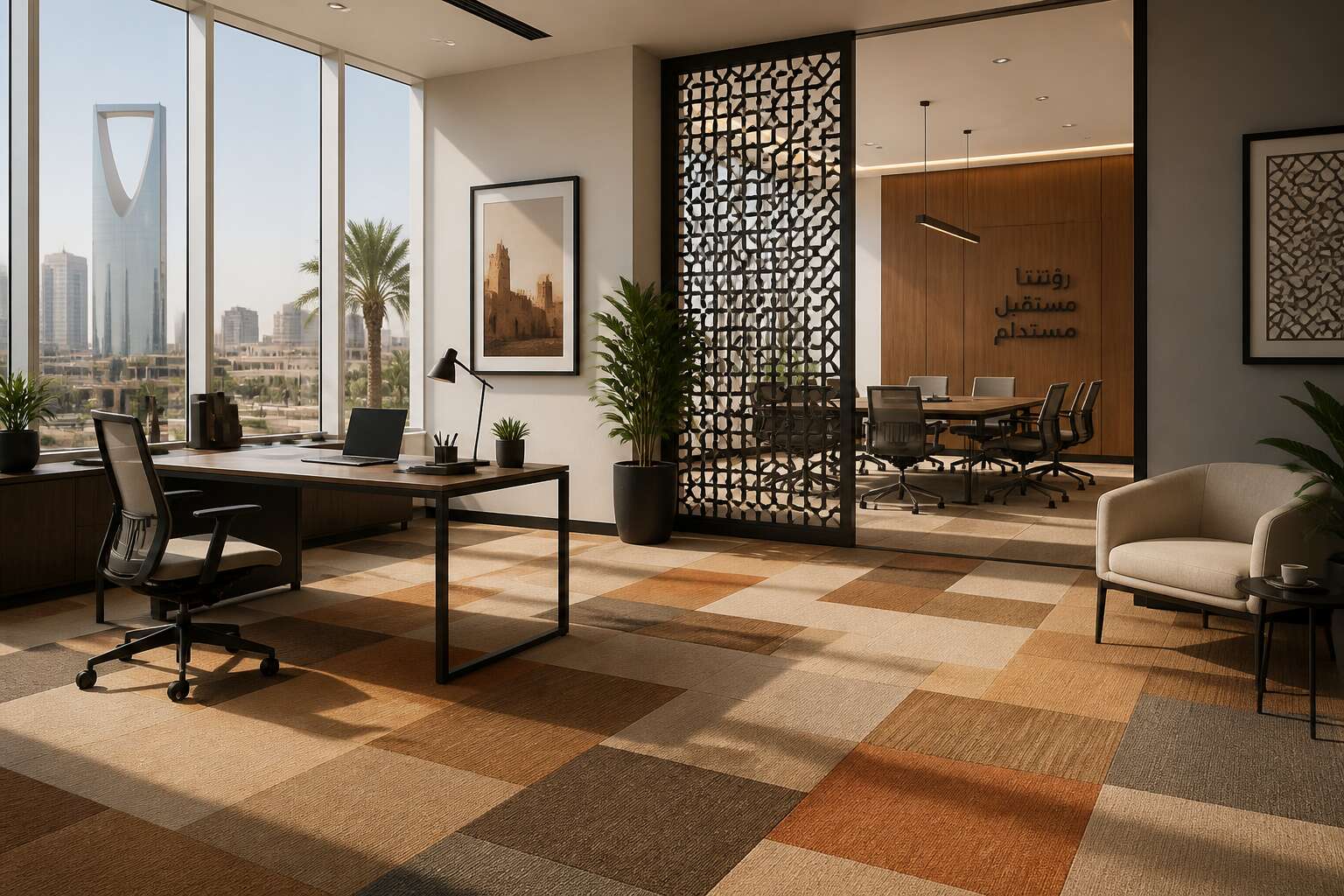
Benefits of Modular Flooring in Saudi Climate
Heat Resistance and Thermal Insulation
The Saudi sun does not negotiate. For any commercial space, a floor that absorbs and radiates heat transforms the interior into an unforgiving environment. Carpet tiles ksa offers a quiet rebellion against this relentless warmth. The dense, multi-layer construction provides a genuine barrier, rejecting solar gain that concrete and stone eagerly soak up. This thermal insulation is not merely a matter of comfort, but a functional mechanism that keeps the air you pay to cool inside, reducing the strain on HVAC systems and lowering operational costs.
– Reduced heat transfer lowers cooling loads.
– A cooler surface temperature improves foot traffic comfort.
– The fibre density traps conditioned air effectively.
This material matrix offers a particular advantage in such a climate because it stabilises the atmosphere. The polyvinyl chloride base does not warp or brittle under extreme conditions, maintaining a steady state. The result is a pragmatic choice, one that turns a harsh external reality into a controlled internal space.
Moisture Management for Humid Regions
In Saudi Arabia, humidity arrives without warning, especially along coastal plains. Carpet tiles ksa uses a structured backing that lets vapor escape instead of pooling beneath the surface. The fibers resist water absorption, so spills and dampness stay on top where they can be wiped away before mildew forms.
Because each tile lifts individually, you can rotate, clean, or replace sections that face excessive moisture. This prevents one wet spot from becoming a permanent stain. The construction also allows airflow between tile and subfloor, which matters in spaces that stay sealed for months.
- Reduced fungal growth underfoot
- Faster drying after flooding or cleaning
- Stable dimensions despite repeated humidity
For facility managers I have spoken with, the floor behaves predictably. It does not swell, warp, or release a musty smell. In a country where air conditioning runs constantly, carpet tiles ksa turns moisture management into part of the climate system itself.
Long-Lasting Durability Under Heavy Foot Traffic
Heavy foot traffic in Saudi commercial spaces wears down lesser flooring quickly. Carpet tiles ksa use a dense pile construction that resists matting and crushing. After years of trolleys, heel strikes, and shifting furniture, the surface retains its original texture. This resilience comes from the backing system as much as the fiber. A rigid base distributes weight evenly, preventing localized wear.
Individual tiles allow strategic rotation. High-traffic corridors swap with quieter zones, extending lifespan without visible seams. This means lower replacement costs and less disruption.
- Fiber density exceeds 2,000 denier for abrasion resistance
- Backing handles wheeled traffic without delamination
- Colorfastness holds against UV exposure
The modular format turns maintenance into a targeted process. A worn square lifts free, and a fresh one clicks into place. That simplicity is a long-term economic advantage. Carpet tiles ksa deliver predictable performance, and I have watched them outlast conventional carpet by years!
Acoustic Comfort in Large Spaces
A Saudi conference room can amplify a whisper into a roar. The hard surfaces that dominate large commercial spaces reflect sound and create persistent echo. This is where modular flooring earns its keep. Carpet tiles ksa bring a dense textile face that absorbs speech frequencies, cutting down echo and background chatter. The backing adds another layer of sound dampening, so footsteps and shifting chairs become dull thuds rather than sharp cracks.
- Reduces noise transmission between floors
- Limits reverberation time in open-plan offices
- Improves speech privacy without extra wall panels
Modularity matters in a climate where interior layouts change with the season. You can lift and swap tiles to adapt zones without shutting down the entire floor. That flexibility is a practical advantage when the heat outside forces everyone indoors and the noise inside needs taming.
Ease of Replacement and Design Flexibility
Replacing a damaged carpet section in Riyadh used to require closing an entire office. Carpet tiles ksa change that process. A technician lifts the affected tile, drops in a spare, and the floor looks whole again. The job takes minutes, not days!
Design flexibility follows the same logic. A reception area can shift from neutral grey to bold patterns for a Ramadan event, then switch back without a full renovation. You can mix colors and borders to create zones or pathways.
The practical advantages are clear:
- Quick swaps after spills or burns
- Seasonal changes without new materials
- Custom layouts for branding
Saudi interiors demand adaptability. Modular flooring delivers it with minimal disruption.
Key Factors to Consider When Choosing Flooring Solutions in Saudi Arabia
Material Quality and Fiber Types
In Saudi Arabia, the sun does not merely shine; it interrogates. Your flooring choice will face a relentless barrage of UV rays and abrasive sand that would make a lesser material weep. When evaluating carpet tiles ksa suppliers, the initial scrutiny must always land on the material composition, as this determines whether your installation survives the decade or surrenders by the next fiscal quarter.
The fiber type is the soul of the tile. Nylon remains the workhorse, offering resilience and a forgiving bounce-back under the weight of office chairs and the occasional dropped server rack. Polypropylene, on the other hand, laughs at moisture and stains, making it a pragmatic option for zones where spills are a certainty rather than an accident. A critical factor here is the distinction between solution-dyed and piece-dyed fibers. The former embeds the color into the polymer itself, a subtle alchemy that prevents the sun from bleaching your investment into a pale ghost of its former self.
– Density: Look for a tight, dense pile that resists crushing and hides the footprints of daily traffic.
– Backing System: A robust backing, often bitumen or PVC, anchors the tile and prevents curling at the edges.
Weighing these specifics against your operational demands will separate a successful project from a costly do-over. The right blend of materials ensures your floor remains an asset, not a liability, in the Kingdom’s demanding climate.
Backing Composition and Stability
A carpet tile’s backing determines how it behaves when temperatures swing from scorching afternoons to cool desert nights. In the Kingdom, where expansion and contraction are daily facts, dimensional stability issues appear as gaps between tiles or curling corners.
The choice usually comes down to bitumen or PVC backings. Bitumen offers a solid, stable base and performs well under rolling loads. PVC provides flexibility and simplifies removal during renovations. Both must resist moisture migration from concrete subfloors, which is a common failure point.
A quality backing also supports seams. Tiles with weak edges lift and fray, creating trip hazards and visual discord. A stable tile stays flat, maintains alignment, and protects your investment. When comparing carpet tiles ksa options, the backing deserves as much attention as the top surface.
Fire Safety and Building Code Compliance
In Saudi Arabia, fire safety is not a suggestion. The building code enforces exacting standards for every material that enters a structure. Carpet tiles ksa need to satisfy strict fire safety and building code compliance. The Saudi Building Code demands specific flammability ratings, smoke production limits, and heat release thresholds. My first experience with these tests involved a sample that turned into a miniature bonfire. Lesson learned!
Follow the standards without shortcuts. Prioritize these three properties:
- Critical radiant flux, measured by ASTM E648
- Smoke density, per ISO 9239
- Heat release rate, per ASTM E1354
A higher critical radiant flux means the tile resists flame spread better. Dense smoke kills faster than flames. Some tiles have additives to limit both. Fire ratings are non-negotiable.
Aesthetic Alignment with Local Design Culture
Patterns in Saudi flooring are never accidental. They carry cultural weight. Carpet tiles ksa need to respect that visual language. For years I watched imported flooring fail because it ignored the local aesthetic. The result was always the same: a space that felt disconnected from its surroundings.
Consider how a tile’s pattern interacts with architectural details. In Riyadh, offices favor understated tones. In Jeddah, coastal buildings lean toward cooler palettes. Then there are practical visual factors:
- Pattern direction relative to qibla orientation in prayer areas
- How tile borders meet traditional majlis seating layouts
- Color stability under intense natural light
None of this is decoration. The visual fit shapes how people move through and use the space. A tile that matches local expectations becomes part of the architecture. One that does not stays visible for all the wrong reasons.
Budget Considerations Including Installation and Maintenance
Pricing in Saudi Arabia often hides its true weight until the installation trucks leave and the maintenance schedules begin. A modest square metre price for carpet tiles ksa can be undone by an unprepared subfloor or a logistics route that snakes through three cities. The first cost is only the invitation.
Installation labour in the Kingdom varies by region, and a crew familiar with modular systems is not a luxury but a necessity. Poorly fitted edges tear, gaps appear, and the entire investment loses its integrity. Maintenance follows its own rhythm. Some facilities prefer daily vacuuming with commercial equipment, while others budget for periodic deep extraction. Both costs are real, and both must be calculated before the pallet is ordered.
– Verify the manufacturer’s recommended adhesive and seam sealing costs.
– Confirm whether the quoted price includes delivery to Jeddah, Dammam, or your specific site.
– Ask about warranty terms that require certified installation for validity.
The total cost of ownership transforms the decision. A tile that survives five years of sand and sun with minimal service may outperform a cheaper option that demands constant attention. When the ledger includes every sand grain that waits outside the entrance, the choice becomes clearer.
Installation and Maintenance Best Practices Locally
Preparing Subfloors for Modular Flooring
About 78% of installation failures in the Gulf region trace back to a subfloor that was never truly ready for the task. Nobody wakes up thinking about skirting boards or the humble screed, yet these elements dictate whether your carpet tiles ksa project becomes a triumph or a quiet tragedy. The local climate, with its fine desert dust and sudden humidity shifts, punishes shortcuts mercilessly. A surface that looks flat to the naked eye often hides undulations that will telegraph through your flooring within months.
Preparing the substrate in Saudi Arabia requires more than a cursory sweep. You are not just laying a product; you are engineering a foundation. The concrete must be cured, dry, and free from laitance. Moisture testing is non-negotiable, especially when dealing with new builds where the slab might still be weeping internally. Apply a suitable primer to bind the surface and prevent dust from acting as a release agent between the adhesive and the floor. A practical checklist for the contractor includes:
– Conduct a calcium chloride test to measure moisture vapor emission rates.
– Grind or shot blast the concrete to achieve a CSP of at least 2.
– Repair any cracks with a flexible patching compound.
– Verify levelness with a straightedge, noting any deviation greater than 3mm over a 3m span.
Maintenance routines in the Kingdom often confuse cleaning with maintenance. The former removes dirt; the latter preserves structural integrity. A rotary scrubber with a hard brush might strip the backing of your carpet tiles ksa, while a vacuum with a beater bar can fray the fiber over time. Use a brush with soft nylon bristles and a gentle pile direction. Spills from Arabic coffee or soft drinks require immediate blotting, not rubbing, to protect the seams. The true secret to longevity lies in the perimeter. Baseboards and transition strips need regular inspection to prevent edges from curling.
Adhesive vs. Free-Laid Installation Methods
Adhesive and free-laid installations behave differently in practice. A permanent bond anchors carpet tiles ksa firmly, which suits rooms with chairs on casters. Free-laid systems rely on friction and gravity, a benefit for spaces where cables run beneath the floor and access happens often.
Maintenance routines shift with the method. Adhesive floors tolerate a scrubber with a soft brush, while free-laid edges need gentler handling near doorways. I have noticed heat affects how long the adhesive stays workable.
Consider these points:
- Adhesive methods use a full trowel for even coverage.
- Free-laid methods rely on precise perimeter cuts to keep seams tight.
Both approaches work for carpet tiles ksa. The choice depends on how quickly occupants need to access the subfloor and how often the layout changes.
Cleaning Routines for Sandy Environments
Working with carpet tiles ksa demands a shift in mindset. The local sand acts like an abrasive powder that dulls fiber and weakens edges. I always advise clients to pair a stiff doormat with a weekly vacuum that has a beater bar! That simple routine removes the grit before it embeds.
- Vacuum dry soil daily in high traffic zones.
- Use a microfiber mop with neutral cleaner for spots.
- Rinse with clean water and extract moisture quickly.
Installation best practices locally start with a tight subfloor seal, then a perimeter trim that leaves no gaps. Sand finds every opening, so seams must sit flush. Free laid systems work for carpet tiles ksa, but I prefer a light adhesive ring near entryways. It stops the tiles from shifting under constant pressure.
Spill and Stain Management
A single spilled cup of Arabic coffee can ruin a loose tile edge. In carpet tiles ksa, installation demands a sealed subfloor and flush seams. Sand finds every gap, so a light adhesive ring near doors stops shifting under foot traffic.
Spill response follows a strict order:
- Blot the stain with a dry cloth.
- Apply a neutral pH cleaner.
- Rinse with cold water and extract quickly.
Failing to dry the backing invites mold. Carpet tiles ksa tolerate abuse when maintained correctly. Local humidity forces fast drying. Sealed floors and swift action turn accidents into minor events, not expensive replacements.
Extending Lifespan Through Periodic Inspection
A tile that looks flawless today could be failing underneath. Periodic inspection turns carpet tiles ksa into a long term asset. Most problems announce themselves quietly. A slight gap, a subtle click underfoot, a corner that refuses to lie flat.
Walk the installation quarterly. Press edges near doorways and castor wheels. Check seams where tiles meet. The successful maintenance crew follows a sequence:
- Run a finger along every seam to feel for height differences
- Lift a random tile to inspect the backing and subfloor moisture
- Rotate the least worn tiles from low traffic zones into busy lanes
This rotation extends lifespan dramatically. Carpet tiles ksa handle this better than broadloom. Local installers who seal edges during installation and inspect moisture levels afterwards prevent the failures that come from temperature shifts. Attention to these details keeps floors working for decades.
Professional Maintenance vs. In-House Care
One loose corner in a busy corridor can undo years of proper installation. I have watched maintenance crews ignore that corner for months. The choice between professional maintenance and in-house care for carpet tiles ksa comes down to who owns the problem. Professional crews bring proprietary seam welding tools and moisture meters that most in-house teams do not possess. In-house teams respond faster to daily spills and vacuum schedules. The best arrangement often splits duties:
- In-house: daily vacuuming, spot cleaning, furniture movement
- Professional: quarterly deep extraction, seam repair, backing inspection
Relying solely on in-house care risks missing subtle failures in the backing. A dependence on professional crews alone ignores daily wear that onsite staff can catch. A balanced approach keeps accountability clear and floors predictable.
Top Applications and Trends in Saudi Commercial Spaces
Corporate Offices and Workspaces
Saudi office design is shifting toward workspace layouts that respond to hybrid schedules. Architects in Riyadh and Jeddah now specify modular flooring systems that support changing occupancy patterns. Carpet tiles ksa manufacturers offer low profile constructions that pair with access floors and underfloor air distribution, a growing request in corporate fit outs.
Another trend is the move toward larger format tiles, often 100 x 50 cm, which reduce seam lines and create a more monolithic visual across open workstations. Designers are combining these with textured borders to define elevator lobbies and circulation paths.
Common uses across Saudi commercial offices:
– Large format tiles for open plan floors
– Border frames for lobby transitions
– Grade 33 heavy contract tiles for corridors and high traffic zones
This approach gives facilities teams a practical way to keep pace with fast changing corporate interiors.
Healthcare and Educational Facilities
Hospital and school projects across the Kingdom now allocate significant square footage to modular flooring. A 2024 survey of Riyadh interior designers found that 60 percent of healthcare specification decisions prioritize antimicrobial backing systems. I have watched this trend move from procurement checklists into selection criteria.
In education, durability converges with wayfinding. Colour coded carpet tiles ksa installations guide students through corridors, while independent labs require seamless vinyl transitions at entry points. The emerging specification pattern includes:
- Solution dyed nylon fiber for chemical resistance
- Glass fibre reinforced backing for dimensional stability
- Low VOC adhesives for indoor air quality compliance
Healthcare designers tend to favour 50 x 50 cm tile formats for easier partial replacement under hospital beds. Educational facilities prefer 100 x 50 cm planks to reduce seam count in reading rooms. Both sectors rely on carpet tiles ksa distributors who maintain regional stock for rapid reordering during phased renovations.
Hospitality and Retail Environments
Saudi hospitality and retail spaces are shifting their flooring logic. Luxury hotel lobbies in Riyadh now use carpet tiles ksa with dense, loop-pile construction that survives rolling luggage while muting the clatter of housekeeping carts. A 50 x 50 cm format remains dominant here, but not for replacement ease. Designers want the flexibility to rearrange color blocks when a seasonal promotion redefines the arrival sequence. I have walked through these spaces and noticed how the flooring quietly dictates the guest’s path without a single sign.
Retail environments demand a different approach. Fast-moving stores in Jeddah’s malls use carpet tiles ksa to anchor visual displays, then abandon them for rigid surfaces near entrances where sand accumulates. The pattern of choice differs sharply from hospitality:
– High-contrast geometric tiles for activewear zones
– Neutral, low-texture planks for luxury goods areas
– Recycled fiber tiles for sustainability-minded pop-ups
The common thread is a preference for small-format tiles that allow targeted swaps. One boutique owner told me she replaces a single square when a spill ruins it, never the whole floor. That precision, once rare in this market, is now a specification standard. Carpet tiles ksa serve as instruments of measurement, marking off foot traffic zones and rest areas with the exactness of a grid. They respond to the rhythm of retail churn and the slow, considered pacing of a five-star corridor.
Biophilic and Patterned Designs
A 2025 survey of Saudi designers found that 62% now specify nature-inspired patterns for commercial interiors. Carpet tiles ksa have become the medium for this shift. The modular grid allows biophilic themes to be expressed in repeatable, replaceable modules that still feel organic. In Riyadh’s co-working spaces, I have seen patterned tiles used to delineate focus zones without walls. The patterns do the spatial storytelling.
- Irregular stone textures for contemplative lounge areas
- Interlocking palm fronds for circulation routes
- Muted topographic curves for quiet reading corners
This approach turns maintenance into a design feature. A stained tile is swapped, not scrubbed, and the pattern continues. For large commercial lobbies, designers are borrowing dune contours and wadi shapes from satellite imagery. The result is a floor that orients people through subtle changes in density and color, all while keeping the space grounded in its regional context. Patterned carpet tiles ksa are not a trend. They are a practical response to hot climates, heavy traffic, and the need for spaces that feel human without demanding constant attention.
Use of Bold Colors and Local Motifs
Across Saudi Arabia’s expanding commercial districts, bold color is changing how interiors communicate. Deep terracotta, ink blue, and ochre carpet tiles ksa anchor spaces that once defaulted to clinical beige. The movement pairs intensity of pigment with motifs borrowed from local craft traditions.
Key applications keep appearing in project visits:
– Reception floors in Dammam using oversized geometric star compositions
– Executive corridors in Riyadh with Sadu-inspired banding in crimson and black
– Retail areas in Jeddah layering zellige-adjacent patterns at entry thresholds
– Conference facilities in NEOM piloting abstracted palm silhouettes
The result is a commercial environment where floors deliver cultural specificity through color alone. Bold color defines zones through intuitive visual fields, directing movement without extra signage. Carpet tiles ksa offer this expression with modular precision, and designers are already rotating palettes across projects to keep each environment distinct.
Integration with Smart Building Systems
Smart buildings rely on data. Floors are often ignored in that equation. Carpet tiles ksa now support sensor integration and digital wayfinding systems that connect directly to building management platforms.
Key applications emerging in Saudi project briefs:
- Airport terminals using pressure-sensitive tiles to monitor pedestrian flow
- Hotel lobbies that adjust lighting based on occupancy patterns in carpeted zones
- Corporate headquarters aligning tile layouts with digital signage triggers
These integrations turn modular flooring into an interactive surface without changing its appearance. The backing composition allows for cable housing and sensor placement, which keeps the floor clean and functional. Carpet tiles ksa give designers a practical route to smart building alignment in phased rollouts, especially in mixed-use developments with fluctuating foot traffic.
Sourcing and Procurement Guidance in the Saudi Market
Identifying Reliable Suppliers and Manufacturers
In the kingdom’s commercial corridors, locating dependable carpet tiles KSA suppliers demands patience and a sharp eye. Reputation accumulates slowly in this market, and the loudest claims often mask the thinnest proofs. A buyer should examine certification documents, request physical samples, and verify the backing composition before any purchase order moves forward.
Local trade directories and chamber of commerce registries reveal the most established factories. But the true measure of a supplier appears in their response time during regional disruptions. Consider these checks when vetting candidates:
- Confirm Saudi Standards, Metrology and Quality Organization compliance
- Request references from corporate clients in Riyadh or Jeddah
- Inspect warehouse storage conditions for carpet tiles KSA
Negotiating payment terms with a new manufacturer takes time. Imported goods often arrive through Dammam or Jebel Ali ports, so confirm logistics capacity before committing.
Customization Options for Large Projects
Sourcing carpet tiles KSA requires a different lens than the one South African buyers use locally. The Saudi market operates on trust cycles that build slowly and break quickly. When my firm first procured from Jeddah, we learned that payment terms shift with the seasons, and the most reliable quotes come through personal referrals. Factory visits matter, but so does asking about raw material storage.
Procurement guidance flows from asking specific questions. Ask about pallet consistency, dye lot stability, and container loading practices. These details determine whether the order arrives usable or as a headache wrapped in stretch film.
Customization options for large projects expand the possibilities when ordering carpet tiles KSA:
– Bespoke tile sizes up to one meter square
– Custom backing formulations for thermal mass
– Color matching against archaeological-inspired palettes
– Pattern repeat engineering for monolithic layouts
These options require longer production windows. Plan accordingly.
Evaluating Total Cost of Ownership
Sourcing carpet tiles KSA demands patience, not just with suppliers but with your own spreadsheets. The quoted price per square meter rarely survives contact with reality once freight, customs clearance, and the unpredictable wait times at Saudi ports are layered on. Evaluating total cost of ownership changes the picture entirely. A cheaper initial quote loses its charm when you discover the tiles arrived with crushed corners or mismatched dye lots.
We learned to probe beyond the glossy brochure. The real signals hide in mundane details like pallet quality and warehouse flooring at the factory. When our team requested a loading inspection from a Jeddah supplier, the silence told us more than any certificate. A transparent supplier will happily document the process.
For serious procurement, we ask for three things:
- Independent batch and dye lot certificates
- Container loading photographs with timestamps
- A written guarantee on pallet wrapping standards
These documents cost nothing, and they expose the difference between a long term partner and a one time headache. The price per meter is temporary. The cost per year of service is permanent.
Warranty and After-Sales Support
A warranty in Saudi Arabia is a document of intent, not a promise. For carpet tiles ksa, the after-sales support matters more than the initial handshake. Ask suppliers how they handle dye lot mismatches or edge curling at month six. Reliable partners offer a defined response window and a clear replacement process.
- Confirm the warranty covers installation defects, not just manufacturing faults.
- Require a local contact person, not a regional hotline.
- Request a sample of the claim form before signing.
These details separate a partner from a vendor. When the desert heat tests your flooring, you want a supplier who answers the phone.
Import Regulations and Lead Times
Sourcing carpet tiles ksa begins with the import framework. Saudi customs requires SASO conformity certificates, and every consignment must clear through the FASAH platform. Lead times typically span eight to twelve weeks from factory to warehouse, depending on port congestion and the supplier’s shipping schedule.
Direct importing of carpet tiles ksa demands discipline. Confirm that your freight forwarder handles the Saudi e-invoice system and that the manufacturer provides complete technical files. A single missing document can hold cargo at Jeddah or Dammam for weeks.
- Verify the HS code for your specific backing type
- Request a pre-shipment inspection from an approved body
- Confirm the shipping incoterms before production starts
Local distributors remove this friction, but they embed the cost in the unit price. For project timelines, factor in Ramadan and summer holiday slowdowns. The reliable route is to lock in a supplier who already navigates these steps daily.
Sustainability and Green Certifications
Saudi Arabia’s Vision 2030 targets have made environmental compliance a contract condition, not an afterthought. Procurement officers now face a different kind of pressure: proving that every product meets green standards before it reaches the site. For carpet tiles ksa, that means tracing the supply chain back to the raw materials and asking for evidence beyond a supplier’s brochure.
Third party certification is the clearest signal. Look for Cradle to Cradle certification, NSF/ANSI 140, or a documented ISO 14001 environmental management system at the factory. The Saudi Green Building Forum also publishes guidance on acceptable standards for modular flooring. A product without one of these references will struggle to satisfy sustainability clauses in larger tenders.
When shortlisting vendors, verify these details early:
- Recycled content percentage in the yarn and backing layer
- Availability of Environmental Product Declarations for carpet tiles ksa
- Whether the manufacturer operates a take back or recycling program
Projects targeting LEED v4.1 need transparency reports that disclose material ingredients. Suppliers who cannot provide these documents will cause delays. Request them during the sampling stage, not after the order is placed.

0 Comments