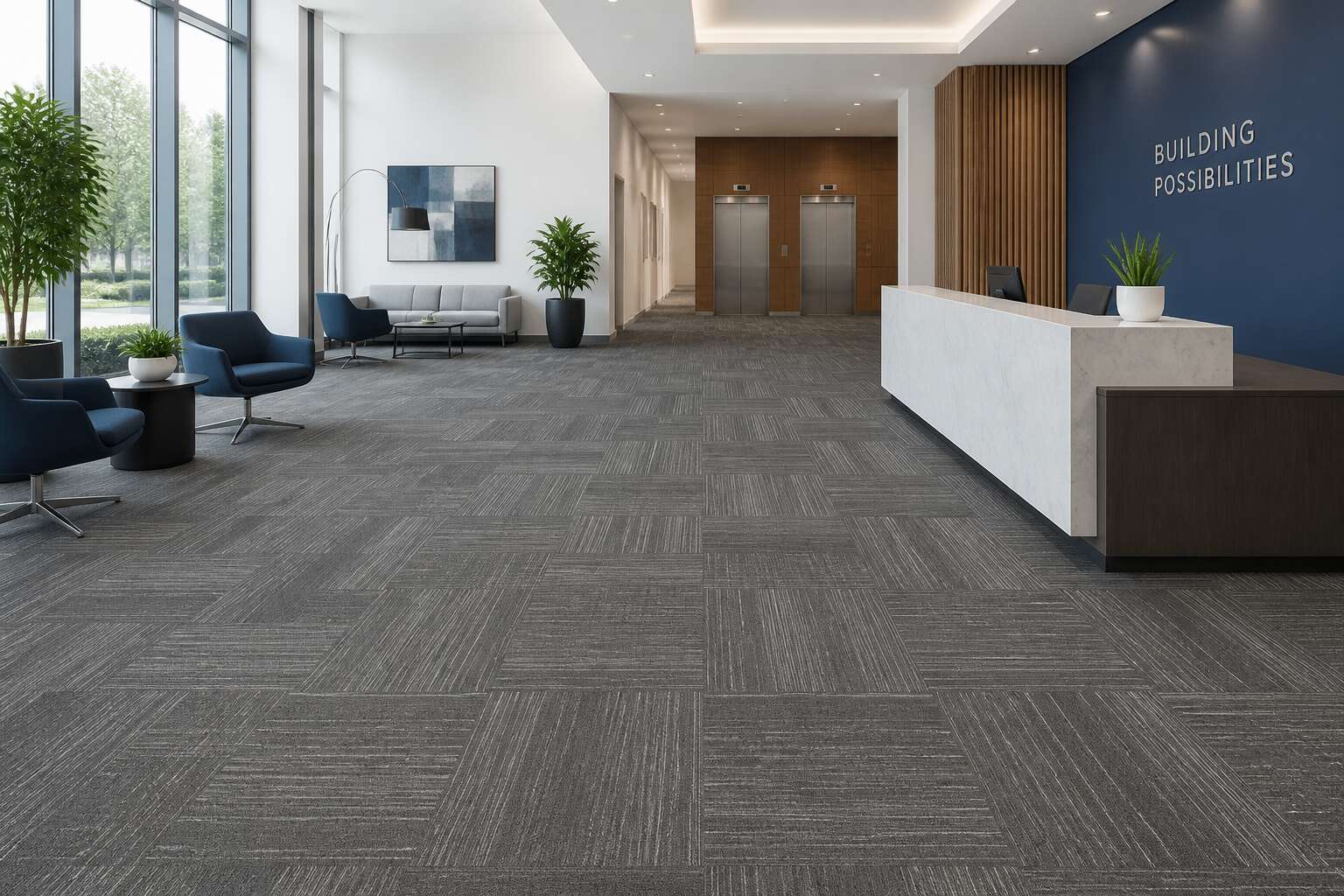
Performance Demands in High-Traffic Business Interiors
Wear Layer Thickness and Fiber Technology Explained
An office floor takes a beating before the lunch hour even begins. In a busy Johannesburg corporate space, research suggests foot traffic can exceed 5,000 crossings per day. This constant movement grinds dirt into surfaces and compresses fibres relentlessly. Carpet tiles commercial grade must withstand this punishment without showing premature wear or looking tired within a year.
The wear layer is the first shield against this abuse. It determines how much texture the tile retains as heels and chair casters pass over it continuously. A thicker wear layer does not mean a stiffer tile, it means the fibre loops are longer and more robust. This extra material allows the pile to resist crushing, so walkways do not become flat, shiny tracks while the rest of the floor still looks new.
Fiber technology has moved beyond simple nylon blends. Modern polyamide 6,6 fibres offer exceptional resilience because their molecular structure creates a stronger bond. This engineered strength means that a chair pushed across the floor leaves no permanent mark.
– Stain resistance becomes a chemical feature of the polymer, not a coating that rubs off
– Dense fibre twisting prevents soil from sinking below the visible surface
– Colour is locked into the fibre structure to resist fading in bright boardrooms
The result is a floor that copes with the daily rhythm of deliveries, meetings, and hurried footsteps. When you select carpet tiles commercial grade, you are not choosing a temporary cosmetic fix. You are investing in a surface engineered for the long haul, one that keeps its grip and appearance under constant pressure. The next section will explore how acoustic comfort and maintenance routines finally seal the performance story for your business.
Abrasion Resistance Ratings You Should Know
Sandton’s lunch rush compresses more foot traffic into one corridor than most retail floors see in a week! Abrasion resistance ratings translate this chaos into accountable numbers. The ISO 9403 Hexapod test simulates foot traffic, grading visual change from one to five. Any score below four signals premature fuzzing or pile loss for carpet tiles commercial grade installation.
The Martindale method offers limited guidance for modular flooring. It measures thread wear on woven cloth, not the crushing and abrasive torque of heels and trolley wheels. We look for a Hexapod score of 4.5 or higher, paired with the EN 985 castor chair test. Together, these ratings reveal how carpet tiles commercial grade cope with open plan movement.
Key indicators:
- Hexapod visual change score of 4.5 under heavy foot traffic
- EN 985 castor chair test exceeding 25,000 cycles without delamination
- Pilling grade of 4, checked at 10 weeks, confirms fibre stability
Stain, Moisture, and Slip Resistance for Daily Workplace Operations
A single spilled cup of coffee can halt an entire open plan floor. In South African offices, where load shedding disrupts cleaning schedules and thunderstorms track moisture through entrances, stain and moisture resistance are essential requirements.
Carpet tiles commercial grade must repel liquids long enough for someone to reach a cloth. We test with actual beverages and cleaning agents used on site. Results vary. A tile that shrugs off tea may permanently stain under industrial degreaser.
Slip resistance matters most in transition zones. Entryways and lift lobbies collect moisture from shoes. The DIN 51130 ramp test grades slip resistance from R9 to R13. We recommend R10 for general areas and R11 for entry points.
Before specifying carpet tiles commercial grade, we check:
- Moisture wicking resistance in the backing
- Fluorochemical repellent in the fibre treatment
- Zone-specific slip ratings
Design Versatility and Aesthetic Control in Corporate Settings
Modular Layouts: Straight Lay, Quarter Turn, and Random Placement
A single room can shift its entire temperament with the turn of a modular tile. In the hands of a designer, carpet tiles commercial grade become a low tech toolkit for altering spatial perception, wayfinding, and the subtle energy of a workspace. The arrangement dictates the rhythm of the floor before a single piece of furniture arrives.
There are three primary arrangements, each with its own visual consequence. These are the foundational patterns of corporate interior design:
- Straight Lay: A disciplined grid where each tile aligns with its neighbor, creating clean, continuous lines that suggest precision and order.
- Quarter Turn: Each tile is rotated ninety degrees from the last, breaking the surface into an interlocking weave that softens the eye’s path and masks directional light.
- Random Placement: A deliberate patternlessness that mimics organic scatter, allowing visual noise to recede and making the grid system impossible to parse.
The choice is not merely decorative. A straight lay strengthens a sense of procession down a long corridor, while a quarter turn can make a large open plan feel more intimate. Random placement offers a homespun texture that hides the footprint of high foot traffic zones within a large expanse. Understanding this spatial grammar grants you a quiet but absolute authority over the look of your interior, where the floor itself becomes a strategy for shaping human behavior.
Color Patterning, Branding, and Wayfinding Opportunities
A floor can encode a corporate identity and steer visitors toward the right door. That is the practical value of carpet tiles commercial grade. Color patterning turns a generic lobby into a defined space.
A clever palette does more than decorate. It defines hierarchy. A deep charcoal zone signals focus. A saturated accent marks the break room. You set the visual hierarchy with every square metre.
Wayfinding becomes effortless. Instead of tacky signage, use tonal shifts and geometric inserts to nudge people in the right direction.
- Bold border stripes for elevator lobbies
- Contrasting arrows for corridor junctions
- Faded logos for reception thresholds
Branding opportunities are not limited to logos. Repeating a signature colour in small doses creates a rhythm that employees absorb subconsciously. Carpet tiles commercial grade offer aesthetic control without locking you into a single design. Swap, replace, iterate. Your floor evolves with your identity.
Textures and Visuals That Reproduce Natural Stone, Wood, and Textile Finishes
The average corporate space is renovated every seven to ten years, but the financial cost of an aesthetic failure is immediate. You can spend a fortune on a design that feels dated within three years, which is why the visual intelligence of carpet tiles commercial grade matters more than the initial pattern. The true power lies in the surface itself. Advanced manufacturing allows these tiles to reproduce the veining of natural stone, the grain of raw oak, and the weave of luxury broadloom with startling verisimilitude. You get the tactile warmth underfoot, but with the material honesty and performance required for a 1,000 square metre office.
This gives the designer a strange kind of control. Wood plank visuals can define a quiet library zone, while a slate finish anchors a high traffic corridor without any of the maintenance headaches of actual masonry. The visual language shifts effortlessly between departments. I have seen a Johannesburg boardroom outfitted in a charcoal stone texture that looked carved from the mountain itself, yet the floor remained warm and quiet.
The technical advantage is customization. Manufacturers can replicate a specific wool tweed or a distressed leather surface, offering a sensory experience that deepens the corporate persona.
– Concrete finishes for industrial heritage buildings.
– Sisal textures for a naturalist brand voice.
– Tumbled marble replicas for a hospitality feel.
You are not buying a floor covering, you are purchasing a specific visual memory for your clients. The tactile feedback changes how people perceive the space. A subtle embossing can mimic the irregularities of handwoven fabric, adding a layer of complexity that a flat vinyl product cannot match.
The genius of these tiles is the modularity. When a section of the “wood” flooring fades under direct sunlight, you lift a tile and replace it. The aesthetic control is absolute. You are not waiting for a whole roll to be reordered or patched. The stone and wood aesthetics also offer a psychological benefit; they imply permanence and stability. A textile finish implies comfort and collaboration. You control that narrative, tile by tile, with zero compromise on durability. The floor becomes a curatorial tool.
Acoustic Performance and Noise Reduction Capabilities
Open plan offices are loud, and loud is expensive. Research suggests that 60 percent of employees struggle to concentrate in noisy environments, and that distraction carries a real financial cost. Carpet tiles commercial grade reduce the problem at its source, absorbing sound through dense fibers and specialized backings that soften footsteps and limit echo.
This acoustic capability becomes a design tool. You can create a quiet zone for focused work next to a lively collaboration area, all without walls or partitions. The carpet does the separation for you. Varying the tile density and backing changes the sound profile of each space, allowing you to shape the atmosphere room by room.
The floor becomes responsive to your workflow. If your team’s needs shift, the tiles shift with them, giving you control over both noise and aesthetics.
Custom Insets, Borders, and Eye-Catching Feature Areas
In corporate settings, the floor often gets ignored until it becomes an eyesore. Carpet tiles commercial grade give you direct control over that surface. Custom insets can hold a company mark, a geometric accent, or a subtle motif in high traffic zones. Borders create defined perimeters, turning a plain corridor into a guided path.
Specific feature areas benefit from this level of design flexibility:
- Reception zones where first impressions settle
- Breakout spaces that need visual energy
- Executive suites requiring understated authority
I have seen designers vary the tile orientation and thickness to produce texture without walls. The aesthetic control covers every seam, every colour shift, every intentional contrast. Carpet tiles commercial grade allow changes without renovation dust. You can make a statement or stay quiet, which is the real luxury.
Long-Term Cost Efficiency and Financial Decision Factors
Initial Price Per Square Foot Versus Total Cost of Ownership
The actual price tag on a floor is often the least revealing number in the specification document. A sharper calculation considers what happens over a decade of daily foot traffic, spilled coffee, and rigorous cleaning schedules. When you factor in the cost of replacement labor, business disruption, and disposal fees, the true ownership expense of a cheap floor becomes a significant liability. This is where the logic of purchasing carpet tiles commercial grade becomes evident, as these products provide a predictable financial outlook that soft, residential alternatives cannot match.
Your initial budget might favor a lower price per square meter, but that figure ignores the reality of maintenance cycles. A floor that wears thin after two years requires complete removal and reinstallation, which is a costly affair. A better approach is to calculate the total cost of ownership over a five to ten year period. This includes the procurement price, the installation time, the cleaning supplies, and the potential loss of rental income if your workspace operates in the hospitality or retail sector.
Consider the specific financial variables that shift the balance in favor of robust flooring:
– Repair costs: With modular tiles, you only replace the damaged section, not the entire room.
– Installation speed: Tiles that click into place without wet adhesives reduce downtime.
– Warranty terms: A manufacturer that backs their product for a decade offers more security than a low upfront price.
The true value of carpet tiles commercial grade lies in their ability to isolate damage. When a liquid spill seeps into a standard broadloom, the entire area must be treated, often requiring expensive specialist intervention. With a tile system, you lift the affected unit, discard it, and install a new one from your stored inventory. This simple action prevents small accidents from becoming capital expenditure events. Over time, this operational efficiency translates into a noticeable difference in your annual facilities budget, leaving you with funds for other improvements instead of constant floor repairs.
Lower Installation Costs Through Reduced Labor and Preparation Time
Installation cost is where budget projections often come undone. A broadloom installation demands extensive subfloor preparation, adhesives, and seam work. Carpet tiles commercial grade change that equation. Their modular nature allows quick, dry lay installation over existing surfaces, cutting labor hours significantly. Some tiles require only a light tackifier or peel and stick backing.
- Reduced preparation time: no need for moisture barriers or elaborate leveling.
- Lower disruption: rooms stay operational while flooring is installed.
- Fewer specialist tools: standard cutting knives and straight edges suffice.
The procurement price remains important, but the installation savings are tangible. Every hour saved is a direct reduction in project cost, and that advantage compounds when you scale across multiple floors. Choose carpet tiles commercial grade to keep capital expenditure predictable and your facility open for business.
Minimal Disruption and Downtime During Replacement Projects
The true cost of a floor unfolds over decades, not days. Carpet tiles commercial grade shift the financial equation by allowing selective replacement. When a broadloom carpet suffers damage, the entire expanse often requires removal. With modular tiles, you swap only the affected units, preserving the rest of the investment. This granular approach to maintenance keeps capital expenditure aligned with actual wear patterns.
Financial decision factors extend beyond the initial purchase. Consider the asset’s lifespan, cleaning requirements, and disposal fees. Modular flooring also reduces downtime during replacement projects. A single tile can be lifted and replaced in minutes, without moving heavy furniture or closing entire zones. That efficiency protects revenue streams in retail environments and maintains productivity in office settings. We treat flooring as a portfolio of replaceable components, not a single monolithic purchase.
Sustainability Goals, Recycling Programs, and Environmental Certifications
South African businesses face pressure to account for their environmental impact. Carpet tiles commercial grade offer a clear path through closed loop recycling programs that divert waste from landfills. Many manufacturers reclaim old tiles and transform them into new backing layers.
The financial decision factors are straightforward! Landfill disposal fees in major metros like Johannesburg and Cape Town keep climbing. A product that returns to the manufacturing cycle avoids those charges entirely.
Environmental certifications like Green Star SA matter for tender submissions and corporate reporting. They signal that your procurement aligns with broader sustainability mandates.
Recycling programs vary by supplier, so verify which ones accept returning tiles:
- Cradle to Cradle certified products
- Take back schemes with documented recovery rates
- Third party audited carbon offset programs
When comparing carpet tiles commercial grade, I ask about recycled content in backing and face fibres. That information impacts long term cost efficiency and sustainability reporting.
Specification Criteria: Construction, Backing, and Installation Options
Primary and Secondary Backing Systems: Bitumen, PVC, Polyurethane, and Felt
Few specifiers examine what sits beneath the visible surface, yet the backing system determines a tile’s entire lifecycle. Carpet tiles commercial grade must withstand the daily stresses of South African workplaces, from rolling chairs to chemical spills. Bitumen backing offers dimensional stability and a firm feel. PVC backing delivers excellent moisture resistance. Polyurethane backing provides flexibility and low VOC emissions, while felt introduces a softer texture and superior acoustic absorption.
Installation options depend on the backing type:
- Loose lay works best with dense, heavy carpet tiles commercial grade and requires zero adhesive.
- Direct glue down suits areas with high foot traffic or where the subfloor is uneven.
- Release adhesive systems permit quick lifts when access to underfloor services is needed.
Each installation method changes the performance and reusability of the tiles, so the choice must match the building’s operational demands.
Fiber Families: Nylon 6 and 6,6, Solution-Dyed Polyester, and Polypropylene
Specifying carpet tiles commercial grade begins with fibre choice. Nylon 6 and 6,6 dominate high traffic spaces because both recover well from compression. Nylon 6,6 offers better heat resistance, while Nylon 6 is easier to recycle. Solution dyed polyester resists fading and staining without topical treatments. Polypropylene handles moisture well but crushes under heavy loads.
Construction density matters as much as the fibre. A tightly tufted face weight with a low gauge creates a stable surface that resists pilling. Dense pile construction also masks seams between modular units.
Backing and installation determine how the tile behaves on site. Compare these factors:
- Dimensional stability of the backing
- Subfloor condition and access requirements
- Reusability after removal
South African buildings, with their mix of air conditioned offices and coastal humidity, demand carpet tiles commercial grade matched carefully to the environment. The right fibre, construction, and backing keep the floor performing for decades without premature replacement.
Face Weight, Density, and Tufted Constructions That Matter
Face weight numbers attract attention, but specifiers overlook tuft density. Dense pile construction prevents pilling and reduces seam visibility. That matters when carpet tiles commercial grade face long hours of foot traffic in a Johannesburg call centre or a Durban hotel lobby.
Tufted constructions vary in gauge and stitch rate. Tight gauge with close rows creates a stable surface that resists compression. Loose gauge with sparse tufts creates maintenance problems later, especially with castor chairs.
Installation options depend on your backing and subfloor:
- Pressure sensitive adhesive (PSA) allows quick access to underfloor cabling
- Loose lay tiles use weight and friction, no glue involved
- Full glue down provides rigidity for heavy rolling loads
The right tuft construction and installation style keeps carpet tiles commercial grade performing without premature replacement.
Installation Methods: Pressure-Sensitive Glue, Loose-Lay, Partial Release, and Interlocking
The quiet specifications often determine whether a floor survives its first decade. Construction details, backing composition, and installation methods carry more weight than aesthetic appeal alone, particularly for carpet tiles commercial grade installed in high-traffic South African environments.
Backing systems influence dimensional stability and moisture resistance. A robust backing prevents curling at edges, which becomes critical in spaces where tiles face daily rolling loads or frequent cleaning cycles. Polyurethane and PVC backings offer different performance characteristics, and your choice affects both installation speed and long-term durability.
Installation options present distinct trade-offs:
– Pressure-sensitive adhesive (PSA) allows quick access to underfloor services, a practical benefit in open-plan offices
– Loose-lay tiles rely on weight and friction, ideal for temporary configurations
– Partial release systems combine flexibility with moderate stability
– Interlocking mechanisms eliminate adhesive requirements entirely
The interaction between tuft density, backing rigidity, and installation method determines how well carpet tiles commercial grade withstand heavy traffic in Johannesburg call centres or Durban hotel corridors. Each element deserves consideration during specification, because retrofitting a poor installation costs more than investing in the right system initially.
Indoor Air Quality, VOC Emissions, and Healthier Building Standards
That proud “new carpet smell” is not a courtesy from the factory. It is the chemical breath of volatile organic compounds, or VOCs, drifting through your ventilation system. For carpet tiles commercial grade, emission profiles matter as much as abrasion ratings, particularly in sealed South African office blocks where fresh air arrives on a strict schedule.
Construction and backing choices alter the chemical story. Polyurethane backings generally release fewer VOCs than their bitumen cousins. Installation methods contribute their own emissions. Adhesive options carry solvent loads. Loose-lay and interlocking systems eliminate that variable completely.
- Check for GREENGUARD certification or equivalent testing
- Review TVOC readings at 72 hours and at seven days
- Request ventilation during installation and for 48 hours after
Healthier building standards increasingly demand this level of scrutiny. Low-emission carpet tiles commercial grade make Green Star SA compliance simpler and keep your staff breathing easier.
Flooring Flatness, Existing Subfloor Conditions, and Moisture Barriers
A subfloor is a geological record of everything that happened before installation. Concrete slabs in South African buildings hold thermal memory, curing moisture, and hydrostatic pressure from water tables that shift with the seasons. Ignoring these conditions creates failures that appear months later as buckled edges, raised seams, or a persistent mustiness that no cleaning regimen can mask.
The relationship between carpet tiles commercial grade and their substrate determines longevity more than any abrasion resistance rating. No degree of manufacturing quality overcomes a slab that moves, breathes, or weeps moisture. Testing protocols should include calcium chloride tests for vapor emission and relative humidity probes embedded in the slab. These measurements reveal what the eye cannot see.
Substrate parameters carry equal weight in the specification process:
– Measure slab flatness tolerances using a straight edge before quoting any installation
– Document moisture vapor emission rates at multiple points across the floor area
– Verify the condition of existing toppings, coatings, or residual adhesive
– Confirm the slab has cured for the duration specified by the backing manufacturer
Moisture barriers present their own set of decisions. Epoxy coatings seal the slab and block vapor drive, yet they require a clean, dry surface to bond properly. Surface grinding prepares the slab for this treatment. The sequence matters. Grinding produces dust that must be vacuumed before any barrier application, and the barrier itself needs time to cure before adhesive touches it.
Flooring flatness tolerances become critical where loose-lay products are specified. These systems rely on friction and weight for stability, so deviations in the substrate surface translate directly into visible lippage between tiles. A strict acceptance criterion protects the visual continuity of the installation. With pressure-sensitive adhesives, minor undulations can be absorbed by the adhesive bed. Loose-lay offers no such forgiveness.
The installation method and the floor condition form a single system. Waterproofing membranes, self-leveling compounds, and vapor barriers each introduce schedule time and cost, but they prevent failures that are far more expensive to correct. When carpet tiles commercial grade are installed over a properly prepared substrate, replacement cycles extend and total cost of ownership shrinks. The specification document should name every product, every tolerance, and every test method. Ambiguity in this document invites failure.
Streamlined Maintenance and Replacement Planning for Facility Teams
Daily Vacuuming Schedules and Equipment for High-Traffic Zones
We have observed that flooring costs emerge after installation. Daily vacuuming in high-traffic zones determines how long the surface stays presentable. For carpet tiles commercial grade, that routine becomes simpler because individual units can be swapped without closing an entire wing.
Choose a commercial upright vacuum with a brush roll that agitates embedded grit. Schedule passes before footfall peaks, ideally between 6 and 8 a.m.! In open-plan offices, a backpack model reduces fatigue while covering large areas quickly.
- Dual-motor vacuums for deep pile
- HEPA filtration to capture allergens
- Cordless units for perimeter sweeps
Replacement planning relies on rotating spare tiles from the same dye lot. A spare stock of 5 percent of total area protects against unexpected damage.
Spot Removal and Periodic Deep Extraction Protocols
Facility teams find that carpet tiles commercial grade endure the abuse of a busy office. A dropped pen, a dragged chair, a leak from the boardroom coffee machine. Each leaves a mark that demands a precise response.
Spot removal starts with a dry cloth to lift loose debris. Apply a citrus-based solvent to the affected tile, working from the edges inward. Avoid saturating the backing. Manage the residue before it sets:
- Blot the stain with a clean microfiber cloth
- Flush the area with warm water
- Extract the moisture immediately
For periodic deep extraction, use a hot water machine with a hand tool. Move slowly across the surface to pull embedded grime. Replacement planning for commercial spaces rarely follows a calendar. Track the wear patterns of each aisle and corner. Rotate tiles from low traffic zones to high traffic zones before the face weight fails.
Tile Rotation, Stock Storage, and Partial Replacement Strategies
Facility teams in South Africa find that carpet tiles commercial grade simplify the endless cycle of wear and repair. A tile near the reception desk will fade faster than one in a quiet corner. Track those patterns. Rotate tiles from low traffic zones to high traffic zones before the face weight fails. This is not guesswork. It is a schedule.
Stock storage is the quiet partner to rotation. Keep spare tiles from the original dye lot. Store them flat, off the concrete floor, away from direct sunlight. When a tile is stained beyond recovery, pull it and slot in a fresh one. Partial replacement costs a fraction of a full refloor.
- Rotate quarterly in high traffic corridors
- Label stock by dye lot and batch number
- Replace damaged tiles within 48 hours
The result is a floor that looks intentional, not patched.

0 Comments