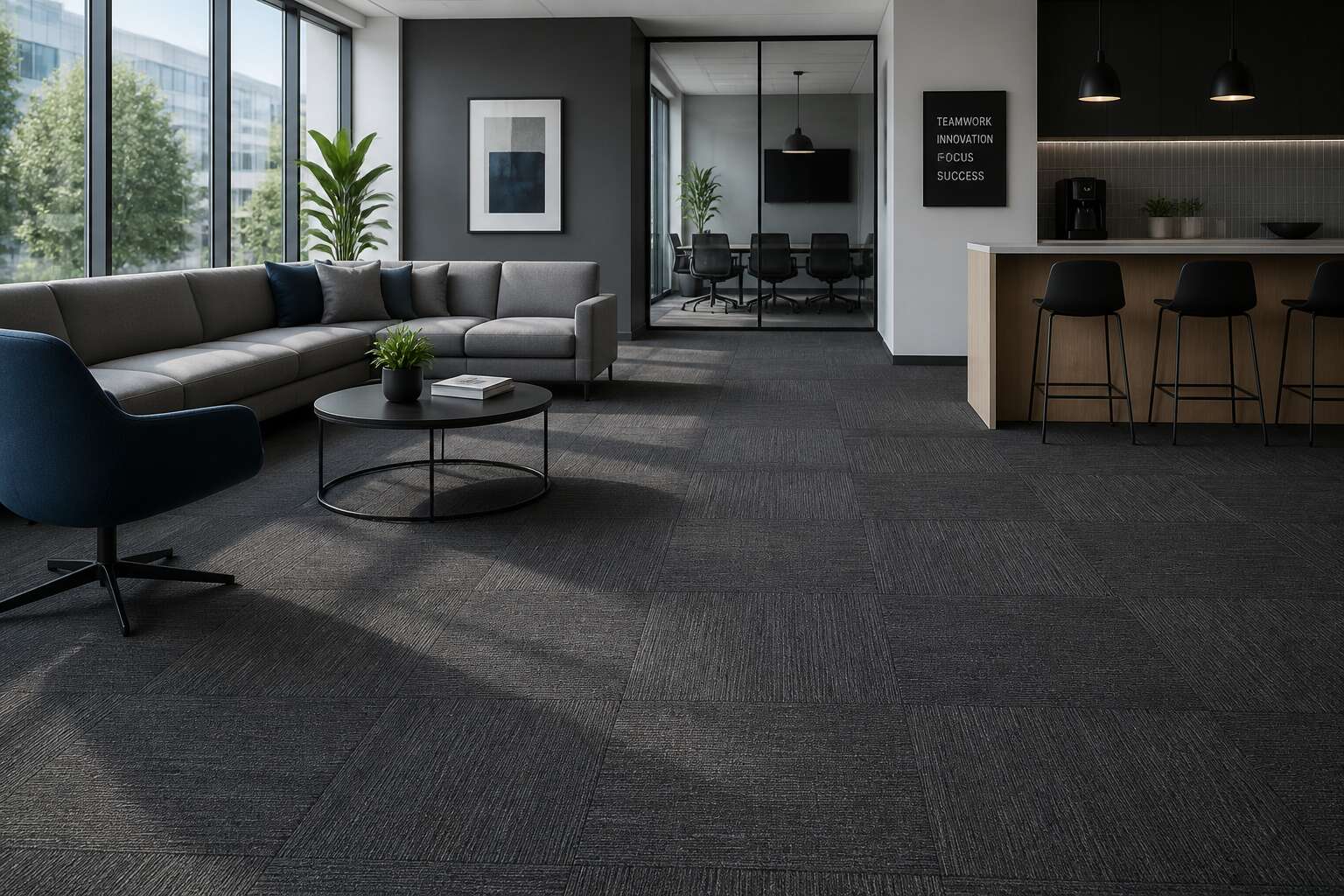
The Visual Impact of Dark Floor Tile Solutions
Setting the Tone: How Dark Finishes Create Sophistication
In South African offices, the shift toward dark flooring has grown by nearly a third since 2020. That is not chance. Dark finishes absorb light, reduce visual clutter, and define a room’s character. The result is a composed atmosphere that lighter palettes rarely match.
For depth, consider the practical effects:
- Dark surfaces make furniture appear more deliberate.
- They hide daily wear in busy corridors.
- They provide a backdrop that lets artwork stand out.
This is where carpet tiles dark grey excel. They give a solid feel without the coldness of stone or the glare of polished concrete. In Cape Town’s design studios, I see dark tiles transform large spaces into intimate rooms! That sophistication comes from restraint, not decoration.
Pairing with Color and Texture for Contrast
Across Durban’s design studios, a curious phenomenon emerges. Interior designers pair carpet tiles dark grey with saturated colours and raw textures to create visual tension. The effect is immediate. A burnt orange cushion against the sombre grey, or a rough linen curtain brushing against the dense pile, changes how the room feels.
Texture becomes the quiet element. Rough sisal mats break the flatness of the tiled floor. Glossy ceramic vases catch the low winter light. Each material responds to the other. The carpet tiles dark grey absorb the first glance, allowing bolder elements to step forward.
- Pale ash timber legs on furniture lift the heaviness
- Handwoven wall pieces in ochre and rust echo the grey without matching it
- Brass or copper fittings add a warm glint against the cool surface
The result is a space that feels considered, not decorated.
Common Aesthetics: From Industrial to Modern Classic
The South African Institute of Interior Design reports that 38% of new office refurbishments now specify carpet tiles dark grey as the base layer. The reason is structural. Dark floors define the spatial logic of a room, positioning furniture and creating a clear visual hierarchy.
Industrial spaces pair these tiles with exposed concrete, black steel, and unfinished timber. The grey works with the raw edges, making the room feel cohesive. Textured tiles with a low sheen mimic polished concrete, while smooth finishes suit modern classic interiors.
- Low pile supports utilitarian character
- Geometric patterns reinforce symmetry
- Dense construction reduces visual noise
The modern classic style prefers quietness. Carpet tiles dark grey in a subtle tweed sit beneath moulded skirting and brass details. The effect is composed. One floor suits both aesthetics, and that versatility merits attention.
Influence of Natural Light on Darker Surfaces
South African light behaves differently. It arrives with intensity, changing how a floor reads. Carpet tiles dark grey absorb that direct sun instead of reflecting it, controlling glare while keeping depth intact. The result shifts by the hour. Morning light exposes each fibre; afternoon light smooths the surface into a dense plane.
Room orientation plays a decisive role. North facing interiors receive ambient light, softening contrast. East facing rooms catch morning rays that exaggerate pile direction. A west facing boardroom produces long shadows by late afternoon.
- East facing spaces use low pile to prevent light catching tufts
- West facing interiors benefit from textured surfaces that scatter light
The same tiles look different in Durban than in Johannesburg. I have watched a single sample shift from charcoal to black between morning and afternoon. Humidity and cloud cover alter daylight diffusion; onsite sample testing has become standard.
Performance Benefits Beyond Appearance
Stain Resistance and Camouflaging Everyday Wear
An estimated 70% of interior wear occurs within the first metre of a doorway, a statistic facility managers in Johannesburg and Cape Town know all too well. Carpet tiles dark grey offer a diplomatic answer to this daily assault. The dense fibre construction resists penetration, while the colour itself absorbs visual chaos.
Consider the common culprits:
- Spilled espresso from a rushed Monday
- Scuffed heels in a busy lift lobby
- Dust tracked in from a construction site
Each becomes far less conspicuous against the darker surface, buying time for proper remediation without the urgent panic of a visible mark. The tile format also permits selective replacement of a single unit, so high traffic zones can be renewed without disturbing the entire floor.
Long-Term Durability in High Traffic Areas
A busy Johannesburg office tower lobby can register over 5,000 crossings per day. Carpet tiles dark grey hold their profile under that load. The key lies in the construction: high twist yarns and dense tufts resist crushing, while the bitumen backing prevents delamination. Edge curl, a common failure in cheaper tiles, stays negligible even near doorways or lift thresholds.
Carpet tiles dark grey also respond well to rolling pressure. Chair castors and trolleys compress the pile, but the fibres bounce back. This recovery rate keeps the surface even, reducing trip hazards and premature wear.
The modular format adds another durability layer. If a tile suffers irreparable damage, you lift it out and click in a replacement. No glue scrapers, no downtime. The surrounding floor remains untouched, keeping the entire installation intact for years.
Allergies and Indoor Air Quality Considerations
Indoor air quality often gets overlooked in office refurbishments. Yet the average Johannesburg workspace holds more airborne particulates than a busy taxi rank. Carpet tiles dark grey act as a passive filter. The dense pile captures dust, pollen, and other allergens before they reach your lungs. This doesn’t happen with hard flooring, where particles endlessly resuspend with every footstep.
- Dust mites and their debris
- Pet dander from home clothing
- Fine grit from outdoor shoes
Modern carpet tiles dark grey come with low emission backings that meet stringent South African indoor air standards. The fibres also release trapped particles during regular vacuuming. That means the floor itself becomes a hygiene tool, not a source of contamination. For people with asthma or sensitivity, the difference is tangible.
Cost-Effectiveness lu Over Time
Sound travels differently across carpet tiles dark grey compared to hard surfaces. The pile and backing absorb airborne noise and dampen impact sound, which transforms a reverberant office into a space where phone calls stay private and meetings remain intelligible. This acoustic benefit appears immediately after installation.
The cost story unfolds over years. Carpet tiles dark grey allow targeted replacement when damage occurs. One damaged tile costs a few hundred rand to replace, while a full carpet installation demands stripping and reinstalling the entire floor. The modular format also grants quick access to underfloor cabling, which matters in older Johannesburg buildings. That is where the real savings accumulate!
Financial advantages stack up:
- Lower material waste during installation
- Reduced labour costs for repairs
- Longer intervals between full replacements
Design Integration and Styling Tips
Choosing the Right Shade of Charcoal din GreyHeather
Most people see charcoal as one flat colour. In reality, a cool charcoal and a warm grey heather sit at opposite ends of the same spectrum, and each changes how a room feels entirely.
I have seen offices where a floor of pure dark grey felt oppressive, yet a heather finish added enough texture for a comfortable, residential feel! Selection should follow the room’s purpose.
- For open plan offices, a lighter heather masks foot traffic patterns.
- For private offices and boardrooms, deeper charcoal defines the furniture layout.
The undertone also matters. A cool blue base suits stainless steel fittings. A warm brown base complements wood veneers. Carpet tiles dark grey in a heather finish are forgiving, but only when the shade matches the existing palette. Testing a sample against your flooring and wall paint will show how the finished floor integrates with the interior.
Coordinating with Walls, Furniture, and Accents
Carpet tiles dark grey work assuredly when the surrounding palette yields to them. In a Johannesburg studio, a warm white wall with a hint of sand allows the floor to define the space without announcing itself. Furniture does not float;it grounds. Walnut legs or gunmetal frames pick up the depth of the tiles, while pale upholstery lifts the composition.
The wall finish matters. Glossy skirting catches light and sharpens the floor’s edge. A matte plaster blurs that boundary. The effect of samples at different hours reveals how shadows alter the tone. Accents serve as punctuation. A terracotta vase or amber glass lamp adds warmth at eye level, ensuring the room avoids monotony. When every surface works together, the floor reads as intentional, not incidental.
Using Patterns to Create Visual Interest
Pattern does more than decorate a floor; it directs how a room is perceived. Carpet tiles dark grey installed in a herringbone layout create a sense of movement, drawing the eye along a corridor or into a seating area. A simple rotation of every second tile produces a checkerboard effect, subtle enough for a boardroom yet distinct enough to hold interest.
Consider these approaches:
- Quarter-turn rotation for a woven texture
- Monolithic layout for a seamless surface
- Staggered brick pattern for a quiet rhythm
In Cape Town offices, designers often use a border of lighter grey tiles to frame a dark grey field. This technique anchors furniture zones without adding visual noise. For larger open spaces, mixing tile sizes or orientations forms a gentle stripe. Carpet tiles dark grey reward deliberate arrangement; the pattern should complement the architecture, not compete with it.
Defining Zones in Open-Plan Spaces
In Cape Town, open plan spaces often blur the line between focused work and collaboration. Carpet tiles dark grey give that boundary a physical anchor. A defined dark field beneath a seating cluster or a management row creates a clear zone while keeping the room visually connected.
Different installations can serve different functions. For example, a straight lay under desks offers a calm work area, while a quarter turn near the coffee point signals a shift in mood. The floor starts to act like a quiet wayfinder.
Carpet tiles dark grey also absorb visual noise in large interiors. When placed as a central island or beneath a long table, they let the architecture breathe. In local offices, this approach supports a natural flow between open desks, meeting corners, and walkways without introducing walls or clutter.
Mixing and Matching Tile Sizes for Custom Looks
When you combine different sizes of carpet tiles dark grey, you create a bespoke surface that standard flooring cannot match. A large format tile anchors a seating area, while smaller squares build a border or path. This interplay of scale adds rhythm to a room without shouting for attention. One practical approach is to alternate two sizes in a staggered pattern. Another is to use small tiles to frame a large central field. Consider these layout ideas:
– Lay large 50cm tiles across the main area, then insert 25cm tiles as a contrasting border.
– Use small tiles to create a subtle checkerboard effect near entryways.
Each cut still fits the same grid, so the dark grey remains cohesive. This method works especially well in Cape Town offices where long sightlines need a touch of texture. The result feels intentional, not accidental, and lets carpet tiles dark grey carry both function and form in equal measure.
Installation Best Practices for Flawless Results
Preparing the Subfloor: Leveling and Cleaning
Nobody notices a perfectly level subfloor, but everyone notices the consequences of a flawed one. For carpet tiles dark grey, installation success begins below the surface. A subfloor that shifts or retains moisture will undo even the most carefully chosen tiles.
First, remove all debris and vacuum thoroughly. Next, check for low spots using a straightedge. Leveling compound fills those dips, while grinding tackles high points. The substrate must be dry, so test with a moisture meter if possible.
Then, consider these essentials:
- Patch cracks wider than a credit card.
- Sand any paint or adhesive residue.
- Prime porous concrete before tiling.
Finally, let the floor acclimate for 24 hours. Patience pays off here! The result is a surface that looks intentional and stays put.
Planning the Layout: Grid, Brick, or Herringbone?
Ask any designer in Johannesburg or Cape Town about the true test of a floor, and they will tell you it is not the tile, but the geometry of its placement. A grid is the quiet conformist of layouts, perfect for those who believe order is a form of hospitality. It offers a predictable rhythm that does not demand attention.
The brick layout, by contrast, introduces a staggered cadence. It is the sensible choice for corridors and offices where movement is constant. The offset joints create a subtle flow that guides the eye forward. For those seeking a more theatrical statement, herringbone is the tailored suit of flooring patterns. It injects a dynamic energy that suits a study or a gallery wall.
Consider the cures each provides for spatial ailments:
1. Grid cures visual chaos, suitable for open areas.
2. Brick cures monotony in long hallways.
3. Herringbone cures a lack of architectural character.
Selecting the pattern for your carpet tiles dark grey is a decision about the room’s social temperature. A grid is austere and intellectual. Herringbone is gregarious and bold. The brick is the reliable friend who always arrives on time. Your choice of carpet tiles dark grey with a distinct pattern changes the perceived square footage, making a small room feel wider or a large room feel intimate. The installation becomes a dialogue between the space and the observer.
Adhesive Selection and Technique for Strong Bonding
A staggering 80% of flooring callbacks involve adhesive failure, not the tile itself. For carpet tiles dark grey, the bond matters as much as the shade. Selecting the right adhesive starts with the substrate. Pressure sensitive adhesive suits most interiors. Wet lay adhesive offers a permanent bond for heavy traffic. Both require a clean, dry surface.
Technique decides the outcome. Spread adhesive with a notched trowel, keeping the ridges uniform. Then wait for the adhesive to become tacky. Press each tile firmly, using a roller to expel trapped air.
- Use the correct trowel notch size.
- Let the adhesive cure to the touch.
- Roll every tile in both directions.
These tiles hide dust well, but they cannot hide a poor installation. Invest in the right adhesive and method, and the floor will stay put for years.
Cutting Tiles Around Obstacles: Tools and Tips
Cutting carpet tiles dark grey around obstacles demands precision. A sharp utility knife with a fresh blade is essential. Use a straightedge as your guide, scoring the backing first. For irregular shapes like pipes, create a paper template first. Transfer the pattern onto the tile backing. Cut from the back to avoid fraying the visible face. A cutting mat protects both blade and floor.
I prefer a hook blade for this job, as it slices through the dense backing cleanly. Always cut slightly oversized. Trim in small increments rather than one bold sweep. This allows for minor adjustments. For door frames, use the undercut method. Slide the tile beneath the jamb. Mark the contact point with chalk. Cut along that line for a seamless fit. Carpet tiles dark grey hide imperfections in the floor, but they cannot hide a ragged edge.
Keep these essentials within reach:
- Fresh blades
- A steel straightedge
- A cutting mat
- Chalk for marking
Avoiding Common Installation Mistakes
Installation errors reveal themselves weeks later, not immediately. Carpet tiles dark grey demand a patient hand. The dense backing needs full adhesive contact. Run a 50 kg roller across every tile, both directions. A missed spot becomes a bubble that grows with foot traffic.
Ignore the directional arrows and you get shadowing. These arrows mark the pile grain. Align them consistently across the entire room. Lay the first row dry first. Check the grain under natural light before you commit adhesive.
- Acclimate tiles for 24 hours
- Verify arrow direction on every tile
- Roll seams twice, then once more after curing
Cool rooms slow the adhesive. Wait for the tack phase before setting tiles. Carpet tiles dark grey forgive slight subfloor unevenness, not a sloppy adhesive bed.
Maintenance and Cleaning Strategies to Extend Lifespan
Daily Routines: Vacuuming and Spot Cleaning
In my experience, maintaining carpet tiles dark grey requires a disciplined approach. The daily ritual of vacuuming removes abrasive grit that can dull fibers over time. For high traffic zones, a commercial grade vacuum with a beater bar is recommendable. Spot cleaning should be addressed immediately, using a mild detergent solution and blotting, not scrubbing, to avoid spreading the stain. This simple regimen preserves the tile’s matte finish.
- Prioritise entrance mats to trap coarse particles before they reach the tiles.
- Use a brush attachment for edges and under desk chairs.
- Schedule deep extraction cleaning quarterly to lift embedded dirt.
Periodically rotating tiles between high and low traffic areas can distribute wear evenly. Since dark grey conceals daily scuffs, a regular cadence of proactive care ensures these squares remain a dignified foundation for years.
Deep Cleaning Methods: Extraction vs. Encapsulation
Ask ten cleaning contractors which deep cleaning method they trust, and you will get ten different answers. Extraction, the traditional approach, injects hot water and detergent into the fibres under pressure, then vacuums out the suspension. It is thorough, but it leaves carpet tiles dark grey wet for hours. That downtime can disrupt a working day.
Encapsulation uses polymers that bind to soil and crystallize into a dry powder. Once vacuumed, the residue goes with it. The process is faster, and the tiles are ready for foot traffic almost immediately. Some facilities run both methods on a rotating schedule.
Consider these points when deciding:
- Extraction handles heavy soil and allergens
- Encapsulation suits regular maintenance and fast turnaround
- Extraction demands ventilation and long drying periods
- Encapsulation reduces water use and detergent residue
For carpet tiles dark grey, encapsulation preserves the matte surface without the risk of water seeping into the adhesive. That protection matters when the tiles sit in open plan spaces with heavy foot traffic.
Handling Tough Stains and Spills Efficiently
One accidental splash of red wine can wipe out years of careful upkeep. The secret lies not in expensive products but in your first move. Blot immediately, never rub. Rubbing forces the stain deeper into the fibres, and on carpet tiles dark grey the resulting streak can be painfully visible. Speed is your ally.
After blotting, match the cleaner to the offender. A quick reference:
- Oil or grease: spray with a citrus degreaser
- Coffee or tea: blot with white vinegar and water
- Ink or marker: dab with isopropyl alcohol
Let the cleaner sit for a minute, then blot with a clean cloth. Always follow with a rinse of warm water to remove residue, which attracts dirt otherwise. In five minutes, you prevent permanent discolouration. Over time, these small acts extend the lifespan of your carpet tiles dark grey considerably, saving you from replacing sections prematurely.
Protecting Edges and Corners from Damage
Most people inspect the centre of a floor, but the corners are where the truth lives. For carpet tiles dark grey, the battle for longevity is fought along the edges, where dust settles and pressure concentrates. I have seen pristine offices undone by curled corners, so treat these borders with respect. A weekly vacuum with a crevice tool is only the start.
Protecting edges and corners requires a deliberate eye. Use a soft brush to sweep away grit that acts like sandpaper. When moving furniture, lift rather than drag, as the sheer weight can dislodge a tile’s adhesive bond. The perimeter is also where moisture sneaks in during mopping, so keep it dry.
- Inspect edges monthly for lifting
- Use a damp cloth to wipe baseboards
- Re-secure loose corners with pressure-sensitive adhesive
I have seen too many clean floors fail at the margins. A few extra minutes of care will keep your carpet tiles dark grey firmly in place. Remember to check the corners after a heavy furniture move or a thorough steam cleaning. These small efforts prevent the unsightly curl that invites further damage. Maintain those boundaries, and your floor will reward you with a longer, more composed life.
When to Replace Individual Tiles?
A 2023 facilities report says the average carpet tile lasts seven years, but only with maintenance. For carpet tiles dark grey, the routine is simple: move furniture regularly to spread pressure, use a dry polymer cleaner instead of water, and focus on the traffic lanes.
Those dark tiles conceal dirt effectively, which tempts you to skip care. Do not! A monthly inspection of the seams and edges catches problems before they spread.
- Check seams for peaking or gaps
- Replace a tile when the fibre is crushed but the backing is intact
- Swap any tile that lifts more than 3 mm at any corner
Replace an individual tile the moment it shows delamination, a permanent indentation, or a rippled backing. Dark grey hides stains, but it cannot hide structural failure. One replacement costs far less than a full rework. Your carpet tiles dark grey will continue to look unbothered and uniform.


0 Comments